

@hyperfrontend/
Higher-order function utilities for behavioral modification and composition.
What is @hyperfrontend/function-utils?
@hyperfrontend/function-utils provides lightweight functional wrappers that modify the execution behavior of functions without changing their signatures. The library focuses on common patterns like single-execution guarantees, conditional execution, error suppression, and no-op placeholders, all implemented as composable higher-order functions.
Each utility maintains the original function's type signature through generic constraints, ensuring type safety while adding behavioral modifications. The implementations use closure-based state management to track execution context (like memoized results or call counts) without external dependencies or complex class hierarchies.
Key Features
Memoize first result and prevent subsequent executions (lazy initialization, singleton setup)
Guard function calls behind runtime predicates without inline conditionals
Silent exception handling for void functions where failures are acceptable
Type-safe no-operation function for default parameters and optional callbacks
Full type preservation
Generic constraints maintain original function signatures through transformations
Zero dependencies
Self-contained higher-order functions with no external dependencies
Minimal overhead
Simple closure-based implementations with negligible performance impact
TypeScript native
Complete type inference with comprehensive JSDoc documentation
Why Use @hyperfrontend/function-utils?
1. Declarative Run-Once Logic Without Manual Guards
Initialization and setup functions often need single-execution guarantees (database connections, singleton initialization, one-time DOM setup). Manual implementation requires scattered boolean flags and conditional checks throughout the codebase. createRunOnceFunction() encapsulates this pattern in a reusable wrapper that memoizes the first result and prevents re-execution.
Example pain point solved: Instead of writing if (initialized) return cachedValue; initialized = true; cachedValue = expensiveSetup(); return cachedValue repeatedly, wrap the function once and call it freely.
2. Separation of Business Logic from Execution Conditions
Mixing business logic with execution conditions (feature flags, permission checks, environment guards) creates coupling and reduces testability. createConditionalExecutionFunction() separates the condition from the action, enabling independent testing of the function logic and the condition predicate.
Example: Logging functions that should only execute in development environments can be wrapped once with an isDevelopment() condition rather than checking the environment at every call site.
3. Intentional Error Suppression for Non-Critical Operations
Some operations (analytics tracking, debug logging, experimental features) should never crash the application if they fail. createErrorIgnoringFunction() explicitly documents error suppression intent through the wrapper, making it clear that failures are expected and acceptable, unlike bare try-catch blocks scattered through code.
Example: Analytics tracking that fails due to network issues shouldn't crash the app. Wrapping the tracking function makes the error suppression explicit and centralized.
4. Foundation for Logger Error Handling
The @hyperfrontend/logging library uses createErrorIgnoringFunction() and createConditionalExecutionFunction() extensively to prevent logging failures from crashing applications and to implement log level filtering. These utilities enable the logger to be resilient and configurable without defensive try-catch blocks throughout the logging implementation.
5. Type-Safe No-Op for Optional Callbacks
Default parameters and optional callback patterns often require placeholder no-op functions. Using () => {} loses type information and creates subtle bugs when functions expect specific signatures. The noop utility provides a type-safe placeholder that accepts any arguments and returns void, working correctly as a default for any callback pattern.
Installation
npm install @hyperfrontend/function-utilsQuick Start
Run-once initialization:
import { createRunOnceFunction } from '@hyperfrontend/function-utils'

// Expensive setup function
function initializeDatabase() {
  console.log('Connecting to database...')
  return { connection: 'db-handle' }
}

// Wrap to ensure single execution
const getDatabase = createRunOnceFunction(initializeDatabase)

// First call executes and caches result
const db1 = getDatabase() // Logs "Connecting..."
// Subsequent calls return cached result
const db2 = getDatabase() // No log, returns cached connection
console.log(db1 === db2) // true
Conditional execution:
import { createConditionalExecutionFunction } from '@hyperfrontend/function-utils'

// Business logic function
function trackAnalytics(event: string, data: object) {
  console.log('Tracking:', event, data)
  // ... send to analytics service
}

// Wrap with feature flag condition
const isDevelopment = () => process.env.NODE_ENV === 'development'
const trackInDev = createConditionalExecutionFunction(trackAnalytics, isDevelopment)

// Only executes in development
trackInDev('user_click', { button: 'submit' }) // Executes in dev, skipped in prod
Error suppression:
import { createErrorIgnoringFunction } from '@hyperfrontend/function-utils'

// Non-critical operation that might fail
function updateLocalCache(key: string, value: any): void {
  localStorage.setItem(key, JSON.stringify(value)) // May throw in incognito
}

// Wrap to prevent crashes
const safeUpdateCache = createErrorIgnoringFunction(updateLocalCache)

// App continues even if localStorage fails
safeUpdateCache('user-prefs', { theme: 'dark' }) // Never throws
No-op placeholder:
import { noop } from '@hyperfrontend/function-utils'

// Function with optional callback
function fetchData(url: string, onSuccess = noop, onError = noop) {
  fetch(url)
    .then((response) => response.json())
    .then(onSuccess)
    .catch(onError)
}

// Caller can omit callbacks safely
fetchData('/api/data') // Uses noop for both callbacks
Composing multiple wrappers:
import { createRunOnceFunction, createConditionalExecutionFunction } from '@hyperfrontend/function-utils'

// Only execute expensive setup once, and only in production
const isProduction = () => process.env.NODE_ENV === 'production'

const setupAnalytics = createRunOnceFunction(
  createConditionalExecutionFunction(() => {
    console.log('Initializing analytics...')
    return { initialized: true }
  }, isProduction)
)

// First call in production initializes, subsequent calls return cached result
// In development, all calls skip execution
API Overview
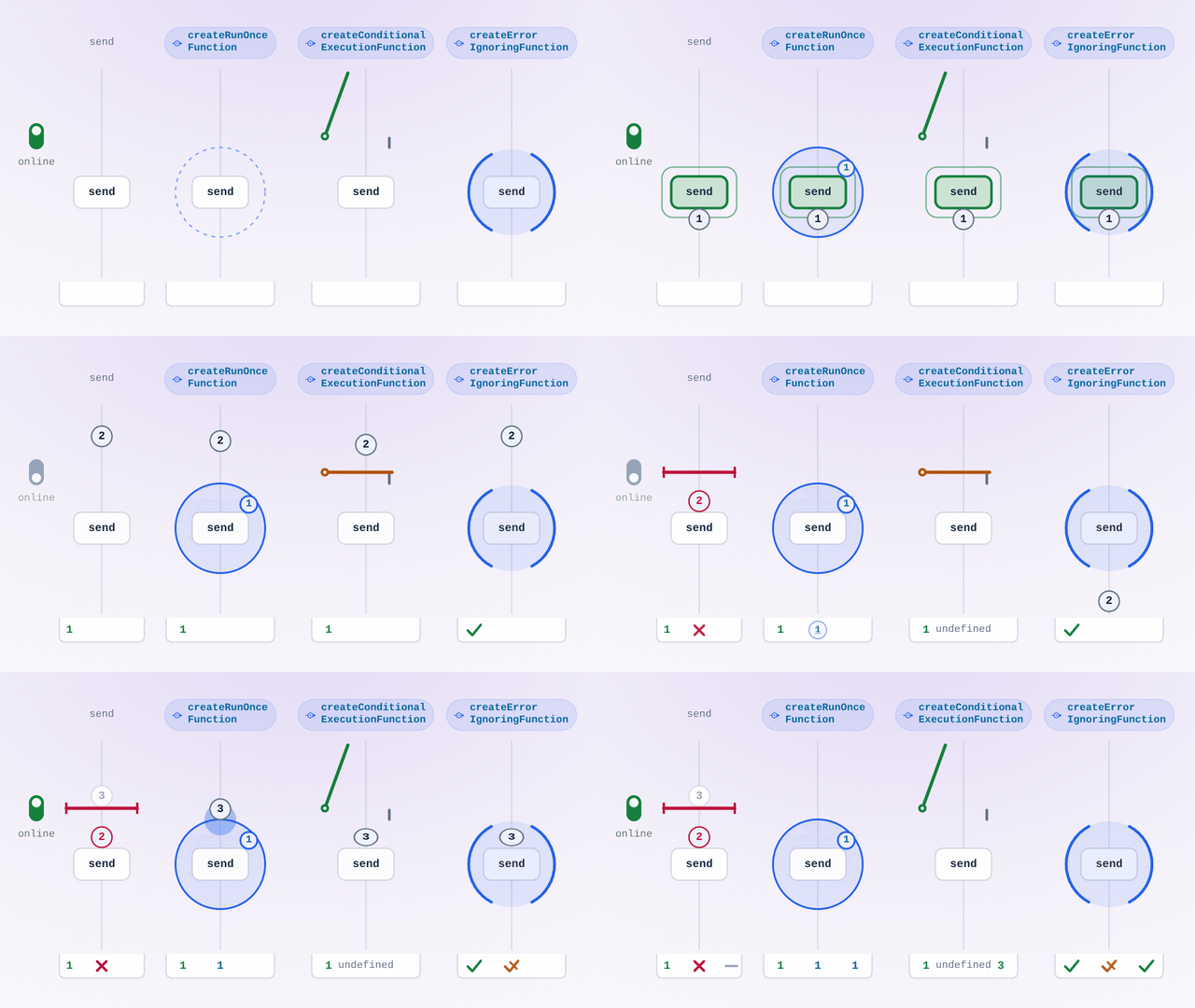
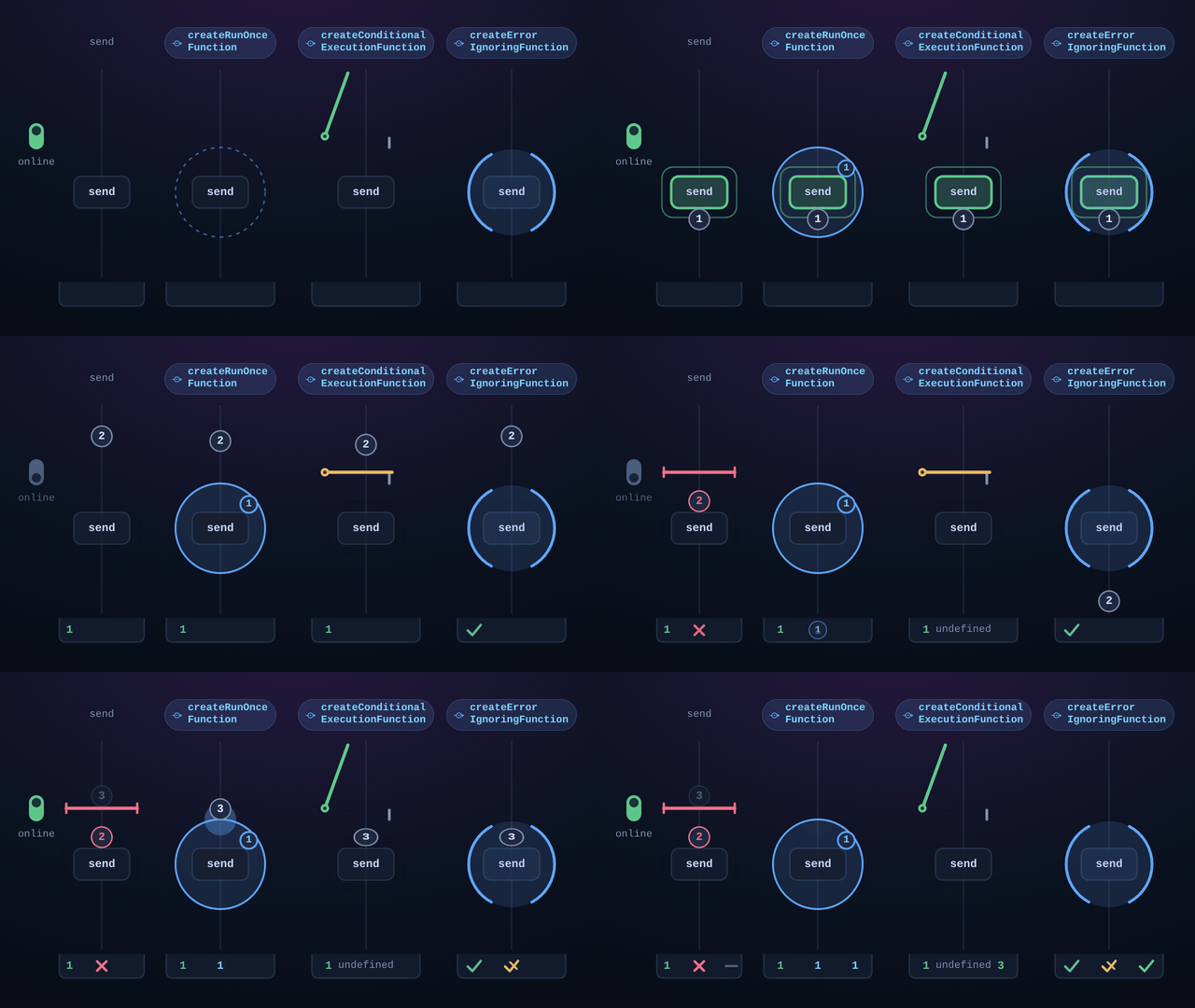
The surface is three higher-order wrappers and one placeholder, and nothing else: no configuration objects, no registry, no state shared between two wrappers. Each
wrapper takes a function and gives back a function you call exactly the way you called the original, because its parameters are typed Parameters<T> and its result is
derived from ReturnType<T>. What a wrapper changes is when, or whether, the underlying call happens.
Start with createRunOnceFunction: it invokes the wrapped function on the
first call, stores that result and returns the stored one for every call after, ignoring their arguments entirely. createConditionalExecutionFunction
takes a second argument, a no-argument predicate that is re-read on every call, and calls through only while it returns true; it is the piece behind log-level filtering
and environment guards. createErrorIgnoringFunction puts the call
inside a try with an empty catch, for work you would rather lose than crash on: analytics beacons, cache writes, debug output.
One typing detail decides between them. Run-once returns ReturnType<T>, and error-ignoring is constrained to functions that already return void, so it returns void
too and quietly discards anything a wrapped function hands back. The conditional wrapper is the only one that widens the return type, to ReturnType<T> | void: when
its predicate is false it never calls through, and the caller receives undefined, so a skipped call is a value you can branch on rather than something to infer.
noop wraps nothing. It takes any arguments and returns nothing, as a typed default for an
optional callback parameter.
Full signatures, generic constraints and per-function examples are in the API reference.
Type Safety
All utilities preserve type information through generic constraints:
// Original function type is preserved
function add(a: number, b: number): number {
  return a + b
}

const addOnce = createRunOnceFunction(add)
// Type: (a: number, b: number) => number ✓

const result: number = addOnce(2, 3) // Type safe ✓
Compatibility
Runs on
- Node.js>=18.0.0supported
- Browserssupported
- Web Workerssupported
Ships as
- ESMTree-shakeable
- CJSNode and older bundlers
- IIFEHyperfrontendFunctionUtils
- UMDHyperfrontendFunctionUtils
CDN Usage
<!-- unpkg -->
<script src="https://unpkg.com/@hyperfrontend/function-utils"></script>

<!-- jsDelivr -->
<script src="https://cdn.jsdelivr.net/npm/@hyperfrontend/function-utils"></script>

<script>
  const { createRunOnceFunction, noop } = HyperfrontendFunctionUtils
  const { createErrorIgnoringFunction } = HyperfrontendFunctionUtils
</script>
Global variable: HyperfrontendFunctionUtils
Dependencies
None: zero external dependencies.
API Reference§
ƒFunctions
createConditionalExecutionFunction<
this.Parameters
Returns
(func that executes conditionally.Examples
Conditional logging based on flag
let enabled = false
const conditionalLog = createConditionalExecutionFunction(console.log, () => enabled)
conditionalLog('test') // does nothing
enabled = true
conditionalLog('test') // logs 'test'
Gating a method you do not own
// an analytics client from a vendor SDK; track() keeps its state on the client itself
const analytics = { queue: [] as string[], track(event: string) { this.queue.push(event) } }
const consent = { granted: false }
analytics.track = createConditionalExecutionFunction(analytics.track, () => consent.granted)
analytics.track('page-view') // dropped while consent is withheld
consent.granted = true
analytics.track('click') // reaches the SDK method, which still finds its queue through `this`this.Parameters
| Name | Type | Description |
|---|---|---|
§func | T | The void function to be wrapped. |
Returns
(Examples
Safely parsing invalid JSON
const safeParse = createErrorIgnoringFunction(() => JSON.parse('invalid'))
safeParse() // silently fails without throwing
Sending a beacon that may fail
const reportMetric = createErrorIgnoringFunction(async (name: string, value: number) => {
  await fetch('/metrics', { method: 'POST', body: JSON.stringify({ name, value }) })
})
reportMetric('render-ms', 12) // a failed request rejects the promise, and that rejection is ignored toothis.Parameters
| Name | Type | Description |
|---|---|---|
§func | T | The function to be wrapped for single execution. |
Returns
(Examples
Single execution initialization
const initialize = createRunOnceFunction(() => {
  console.log('Initializing...')
  return { ready: true }
})
initialize() // logs 'Initializing...', returns { ready: true }
initialize() // returns { ready: true } (no re-initialization)
Memoizing a method you do not own
// a client from a vendor SDK; loadConfig() reads the endpoint it was constructed with
const client = { endpoint: 'https://api.example.com', loadConfig() { return fetch(`${this.endpoint}/config`) } }
client.loadConfig = createRunOnceFunction(client.loadConfig)
const first = client.loadConfig() // one request, made against the client's own endpoint
const again = client.loadConfig() // the same promise, no second request
first === again // => trueFunction keyword.Parameters
| Name | Type | Description |
|---|---|---|
§...args | unknown[ | Any arguments passed to the function (ignored) |
Example
Using noop as fallback callback
const callback = condition ? handleEvent : noop
callback() // safely does nothing if condition is falseRelated reading§
- Package
@hyperfrontend/logging
Used by @hyperfrontend/logging for error suppression and conditional execution
- Getting started
Getting Started
Set HyperFrontend up and embed a first feature.
- Architecture
Architecture Guide
How the packages fit together.
No guides cover @hyperfrontend/function-utils yet.Request one